
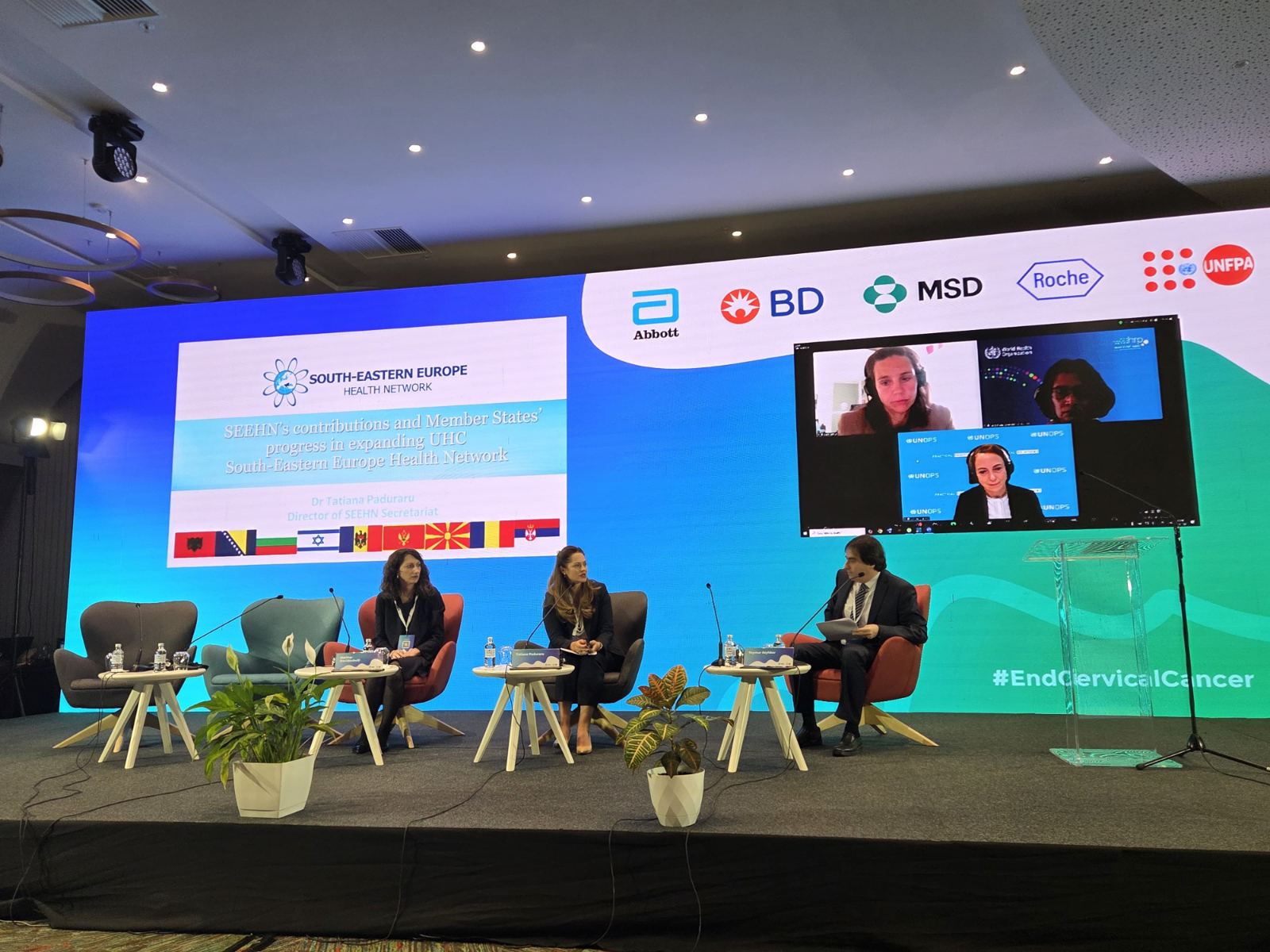

Skopje, North Macedonia – 2 October 2025
The South Eastern Europe Health Network (SEEHN) actively contributed to the Annual Forum of the Regional Alliance for Cervical Cancer Prevention in Eastern Europe and Central Asia, held in Skopje from 30 September to 2 October 2025.
Dr. Tatiana Paduraru, Director of the SEEHN Secretariat, delivered a keynote intervention during Session 1 on Universal Health Coverage to Accelerate Progress in Cervical Cancer Prevention. She emphasized that while cervical cancer is one of the most preventable cancers, it remains a leading cause of mortality among women in South-Eastern Europe due to gaps in HPV vaccination, screening, and access to treatment.
Dr. Paduraru underlined SEEHN’s role as the only intergovernmental regional platform dedicated to health cooperation across nine Member States, with more than 23 years of collective action. She highlighted the contributions of SEEHN’s Regional Health Development Centers (RHDCs) — including the RHDC on Sexual and Reproductive Health in Romania, RHDC on Communicable Diseases in Albania and the RHDC on Non-Communicable Diseases in Montenegro — in advancing prevention, policy advocacy, and capacity building.
Key messages from SEEHN’s intervention included:
- The need to strengthen HPV vaccination coverage through school-based and community programs.
- Expanding organized screening, supported by interoperable digital registries.
- Ensuring equitable access to diagnostics and treatment, especially in rural and underserved areas.
- Leveraging EU and international partnerships for sustainable financing.
- Building trust through awareness and addressing stigma around sexual and reproductive health.
“Cervical cancer is preventable, yet too many women in South-Eastern Europe are still dying from it. This is unacceptable. Together, we can make elimination not only a vision but a regional reality,” said Dr. Paduraru.
The Forum, convened by UNFPA in partnership with WHO/Europe and regional stakeholders, served as a platform to align strategies, reinforcing commitments to universal health coverage and gender equity.