Skopje, 24 September 2026
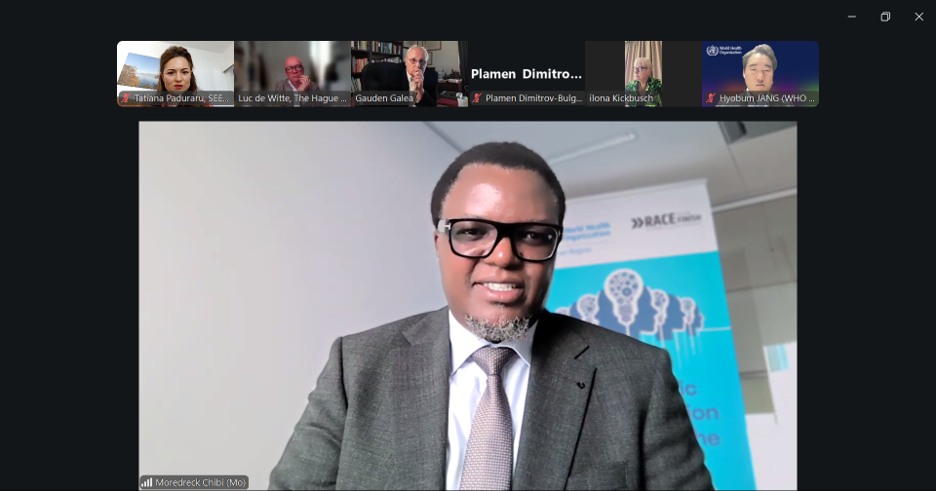
The South-Eastern Europe Health Network (SEEHN) contributed to the virtual side event of the 76th Session of the WHO Regional Committee for Europe, “Showcasing innovation for public health: from intelligence to concrete innovations ready to scale,” held on 22 September 2026.
The event brought together senior health leaders, experts and partners to discuss how emerging innovations can move beyond promising ideas and become sustainable approaches embedded in health systems, governance and financing. The programme included the presentation of early regional horizon-scanning work on innovations for healthy ageing, followed by a high-level panel examining the policy implications of five emerging innovation areas.
Dr Tatiana Păduraru, Head of the SEEHN Secretariat, participated as a panelist alongside Ilona Kickbusch, Shamsullozod Manuchehr, Iveta Nagyova and Hyobum Jang, following keynote and horizon-scanning contributions from Gauden Galea and Luc de Witte.
From innovation to implementation
Speaking from the perspective of SEEHN and its nine Member States, Dr Păduraru emphasized that the challenge is not always a lack of innovative ideas.
“We need to move from projects to systems, from pilots to scale, and from participation as an activity to participation as a principle of health-system design.”
Her contribution focused particularly on community building and social participation as an essential dimension of innovation for healthy ageing.
She highlighted that many approaches already have a strong foundation of experience — including social prescribing, peer support, community connectors, intergenerational initiatives, informal-care support and age-friendly communities. The challenge is to create the policy, governance and financing conditions that allow such approaches to become part of routine health and social systems rather than remaining isolated projects.
Innovation requires governance, investment and collaboration
Dr Păduraru stressed that community-centred innovation cannot depend solely on short-term projects or individual champions. Sustainable implementation requires clear mandates, appropriate financing, delivery capacity and coordination between health services, social services, civil society, education, and communities.
She also highlighted the importance of ensuring that innovation reaches people who are most at risk of exclusion — including people experiencing social isolation, frailty, disability, poverty, rural isolation or digital exclusion.
“The real innovation is creating the architecture that allows these actors to work together.”
This perspective aligns closely with the broader objective of the WHO Europe session: strengthening the innovation ecosystem and helping countries close the gap between promising innovations and sustainable adoption at scale.
Five areas for the future of healthy ageing
The discussion also drew on Luc de Witte’s horizon-scanning work, presented during the event, identifying emerging areas of innovation relevant to healthy ageing.
These include:
🔹 Self-management, Prevention and lifestyle support — strengthening opportunities for people to maintain health and independence in their everyday environments;
🔹 Technology and digital solutions — including remote care, digital health applications and technologies that can support people to live independently;
🔹 Age-friendly housing & environments — creating physical and social environments that enable older people to maintain functioning and participation;
🔹 Community-building and social participation— strengthening community connections, social participation and locally based support;
🔹 Integrated care policies — connecting health, social and community services around the needs of individuals rather than around institutional boundaries.
For SEEHN, these areas are particularly relevant as Member States respond to population ageing, NCDs, workforce pressures, social isolation and growing inequalities between and within communities.
A regional role for SEEHN
Dr Păduraru underlined the value of regional cooperation and peer learning in helping countries move from innovation to implementation.
With nine Member States representing diverse health systems and socioeconomic contexts, SEEHN can provide a platform for countries to exchange experience, understand what makes an innovation work, adapt approaches to different contexts and identify the policy and institutional conditions required for scale-up.
Rather than simply replicating a model developed elsewhere, countries can ask what can realistically be transferred, what needs to be adapted and what enabling conditions are necessary.
The event’s emphasis on moving from intelligence to concrete innovations ready to scale provides an important basis for continued cooperation among WHO/Europe, Member States and regional networks such as SEEHN.