Bucharest, Romania | 21–22 April 2026
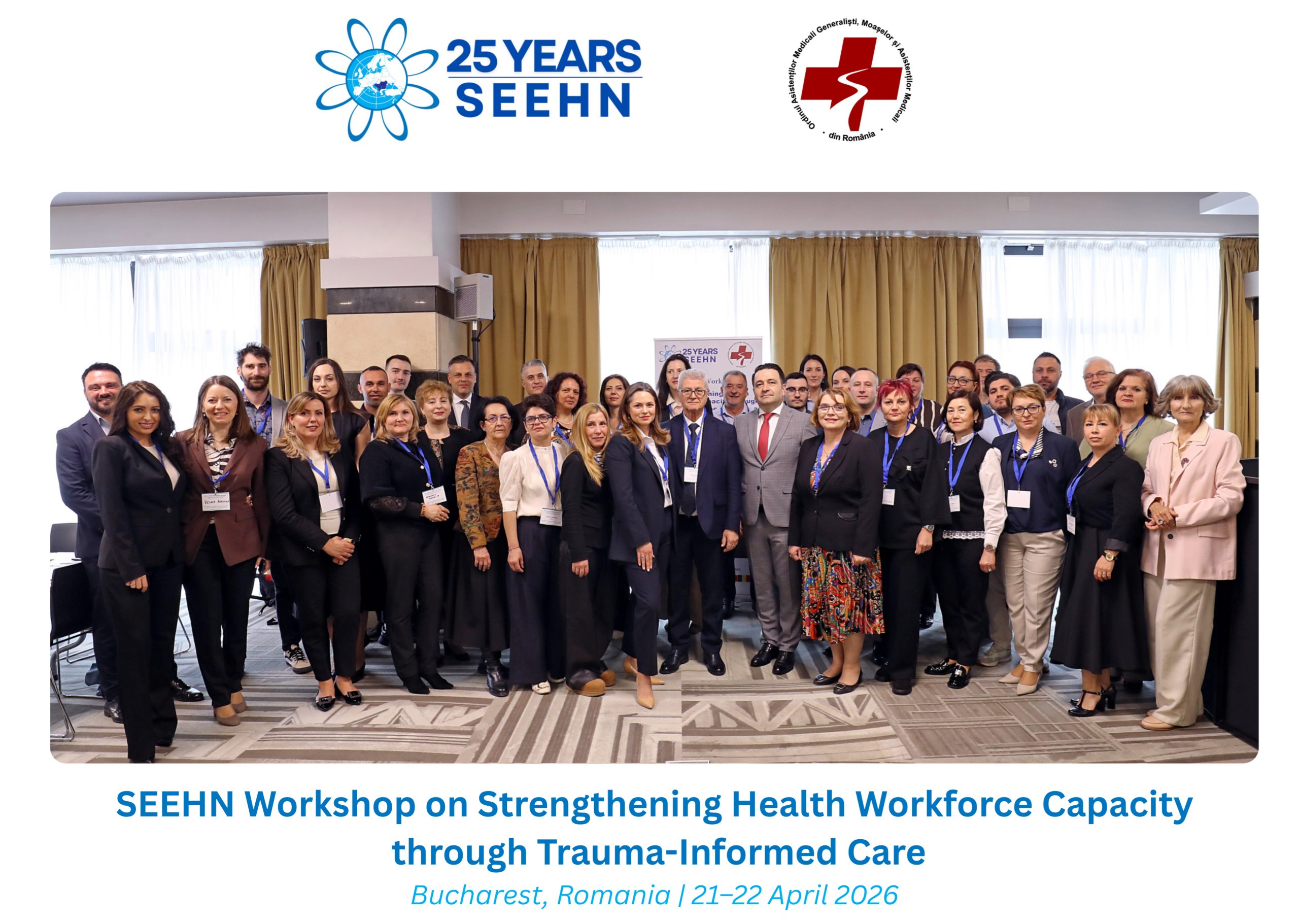
The South-Eastern Europe Health Network (SEEHN) successfully held the regional workshop “Strengthening Health Workforce Capacity through Trauma-Informed Care as a System Competency” in Bucharest on 21–22 April 2026.
The event was organized by the SEEHN Secretariat, in collaboration with the SEEHN Regional Health Development Centre on Nursing and Midwifery, and hosted by the Romanian Order of Nurses, Midwives and Medical Assistants, in partnership with UK Diaspora for Health.
The workshop brought together representatives from SEEHN Member States, including Albania, Bosnia and Herzegovina, Republic of Moldova, North Macedonia, Montenegro, and Serbia, as well as representatives of the SEEHN Secretariat .
In addition, the event benefited from the participation of nurses from Romania, representing healthcare facilities under both the Ministry of Health and the Ministry of Internal Affairs. Members of the Board of the Romanian Order of Nurses, Midwives and Medical Assistants, as well as representatives of the Centre for Psychosociology of the Ministry of Internal Affairs, were also in attendance .
Opening Session
The event was opened by Mircea Timofte, President of the Romanian Order of Nurses, Midwives and Medical Assistants. High-level representatives also delivered keynote remarks, including:
- Claudiu Damian, State Secretary, Ministry of Health of Romania
- Tatiana Paduraru, Head of SEEHN Secretariat
- Florentina Furtunescu, Member of the SEEHN Executive Committee
- Silvia Gatscher, WHO Country Office
The session highlighted the importance of regional cooperation and the growing role of trauma-informed approaches in strengthening health workforce resilience. The session was moderated by Roxana Hainagiu, representative of the SEEHN RHDC on Nursing and Midwifery.
Discussions focused on positioning trauma-informed care as a system-level competency, with key areas including:
- Leadership and governance: integrating trauma-informed principles into decision-making, management, and institutional processes
- System impact: identifying how organizational practices can either support or negatively affect healthcare professionals and patients
- Practical implementation: case-based learning from the United Kingdom, focusing on staff wellbeing, patient safety, and system response under pressure
- Regional applicability: identifying common needs across SEEHN countries, barriers to implementation, and opportunities for joint initiatives
The sessions were led by Dr Nistor Becia, MBE, with contributions from Daniela Nedelcu, in an interactive and practice-oriented format.
Participants emphasized the need to move from concept to implementation, identifying follow-up actions such as the development of advanced training modules, the exchange of best practices, and the creation of regional case studies.
The workshop reaffirmed SEEHN’s role as a platform for regional cooperation and knowledge exchange, supporting Member States in strengthening health systems and health workforce capacity.