News
Under the current SEEHN presidency of the Ministry of Health of Albania, the Minister of Health of the Republic of Albania and current President of the Network Mr. Ilir Beqaj, organized a high-level Meeting and the 36th Plenary of the South-eastern Europe Health Network on December 10-11, 2015 in Tirana, Albania. Following up on the previous two Ministerial meetings held in Skopje and Belgrade, it brought into focus the topic of “Strengthening health systems for universal health coverage towards improved health and wellbeing”.nnThrough open and lively discussion, the senior representatives focused on Universal Health Coverage (UHC), the state of art in each one of the SEE countries, their challenges, actions and the potential for joint regional activities in 2016 and onwards. A number of common challenges were identified that pose barriers to achieving the goals of UHC, for example, insufficient monitoring and evaluation capacities and inadequate health workforce. The High Level Meeting requested extended technical support from WHO Regional Office for Europe which will involve both UHC and people-centred integrated health services delivery.nnThe major humanitarian crisis and the emerging health risks that Europe and the SEE region are facing due to the displacement and migration of populations across the Region, caused by natural and manmade disasters, require both stronger sub-regional presence in the regional discussions on health and other health-related issues that might affect the health systems and economies of the SEEHN Member States in the coming decades, and well-informed and well-implemented government policies.nnWith this in view, the meeting provided the high level representatives of SEEHN member states with the opportunity to share their own national challenges, needs and ideas for potential regional actions in the framework of the Network and the SEE Regional Cooperation Process and to agree on joint regional and national actions for securing universal health coverage in the context of migration and health and health security needs and challenges, thus reaffirming their political commitment to the sub-regional collaboration in the SEE.nnFinally, the intensive regional collaboration, its discussions and several important decisions paved the way towards further increasing the efficacy of the SEEHN in 2016, the next Fourth SEE Ministerial Forum in 2016 to be held in Chisinau under the auspices of the Government of the Republic of Moldova.nn

News
As part of the Albanian presidency of SEEHN (South East European Health Network), a two day workshop was held in Tirana, Albania, entitled Improving data for policy. Members of the Network, which includes representatives from Albania, Bosnia and Herzegovina, Bulgaria, Croatia, Israel, Montenegro, the Republic of Moldova, Romania, Serbia and the former Yugoslav Republic of Macedonia, sent senior health information experts, leaders and decision-makers to participate. Principal topics were strengthening health information systems and also vital registration systems, recording essential information such as births and deaths.nnShared goals and shared challengesnnAs well as providing a forum for networking and exchanging ideas, the workshop was an opportunity to discuss models of health information networks operating in the European Region and also to enable partner countries to discuss such models for the SEEHN community, identify common ground and challenges that could be addressed collectively.nnAt the workshop, participants were unanimous in their recommendation that SEEHN countries should establish a health information network – a clear recognition of the importance of health information in establishing an evidence base for decision making in health policy. WHO will be organizing a workshop next year where countries will agree on the modus operandi and terms of reference of such a network.nn nnLinksn
n nnLocations for postingn
n nnPhoto gallerynn
News
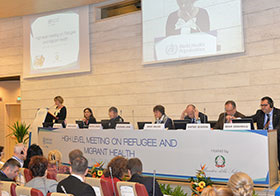
On 23-24 November 2015 in Rome, Italy, upon request at the 65th session of the WHO Regional Committee for Europe this September, the Italian Government and its Ministry of Health hosted a WHO High-level meeting on refugee and migrant health.nnThe attending Ministers and senior representatives of Member States of the WHO European Region discussed about the numerous public health challenges posed by large-scale movements of refugees and migrants to transit and destination countries. Ms Beatrice Lorenzin, Minister of Health of Italy, opened the meeting with a short statement conveying His Holiness Pope Francis’ welcoming to the Conference and calling on Ministers to bring wisdom, strength and peace to the discussions. She also, paid tribute to the health workers who are stepping up for the challenges of the health service regarding the constantly increasing numbers of refugees and migrants arriving at Italy’s boarders. Representatives of the Office of the United Nations High Commissioner for Refugees, the United Nations Children’s Fund, the European Commission, the European Centre for Disease Prevention and Control and the International Organization for Migration also took part and attended this meeting.nnThis high-level meeting provided an opportunity for defying the main public health and health system challenges that the host countries are facing such as, preparedness for immediate response and efficient acceptance of large groups that are complex, resource-intensive and potentially socially disruptive.nnDr Zsuzsanna Jakab, WHO Regional Director for Europe, highlighted that this is not a new phenomenon but the scale of migration is and the ageing population and migration are the two demographic factors that will shape the health challenges of the European Region in the 21st century. She explained that the meeting is for the public health aspects of migration – not the political or security aspects. As a WHO Regional Director for Europe, Dr Jakab stated that we as a Region must seek to ensure that all countries are adequately prepared and organized to withstand the added pressures of supporting a mass influx of people, while at the same time protecting the health of their resident populations.nnIn her concluding comments, Dr Jakab reaffirmed: “As the European public health community, we must do what we can to respond to the needs of those fleeing, to see that they are cared for in both the short and longer terms, and that our health systems are able to deal effectively and humanely with these extra demands, whilst continuing to offer full services to resident populations. We have the tools and knowledge to succeed.”nnDr Santino Severoni, Coordinator of the Public Health Aspects of Migration in Europe (PHAME) project at WHO Regional Office for Europe, addressed the changing face of migration into the European Region and the focus areas of the PHAME project. He said that the goals of the PHAME project are to reduce excess mortality and morbidity, minimize the negative impacts of migration, avoid disparities in health status and access and ensure the rights of refugees and migrants to health care.nn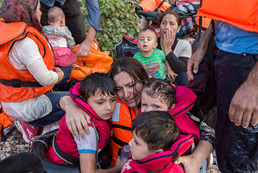 In addition, the panel discussion on the public health aspects of migration defining the challenges presented by communicable and non-communicable diseases. Panellists placed the focus on health care, social services and education which must coordinate to provide effective support, particularly to the most vulnerable. They emphasized the commitment to provide universal access to health services, including services on arrival or on transit routes that are typically provided by NGOs. Dr Nedret Emiroglu, Director of the Division of Communicable Diseases and Health Security at WHO/Europe noted that refugees are more vulnerable on diseases than local population.nnClosing the meeting, Dr Zsuzsanna Jakab thanked the Government of Italy for hosting the event and noted that the Regional Office can support Member States in coordinating efforts and working on many of the tasks identified during the meeting.nnThe migration and health will also be one of the main topics of the 36th Plenary Meeting of the South-eastern Europe Health Network (SEEHN) that will take place in Tirana on December 10th, 2015.nnLinks:n