In view of the need for further strengthening of both regional collaboration for public health and the governance structures of the South-east Europe Health Network, an ad-hoc Meeting of the Ministers of Health of the SEEHN Member Countries titled “Further Steps to Strengthening the SEE Regional Collaboration for Public Health” will be held on 21-23 June 2015 in Belgrade.
Jointly organized by the Regional Director of the WHO Regional Office for Europe, Dr. Zsuzsanna Jakab and the Minister of Health of the Republic of Serbia and current President of the SEEHN, Dr. Zlatibor Lončar the Ministerial Meeting will precede the 35th Plenary Meeting of the SEEHN to take place on 23-24 June 2015 in the same venue.
During these two important events, relevant stakeholders shall exchange views, experience and lessons learned on the top common priorities of the SEEHN Member States, including the implementation of WHO Europe Health2020 and the Health dimension objectives and measures of the SEE 2020 Strategy. By determining the next intersectoral actions for health, the high-level representatives of the SEEHN Member States and the WHO Regional Office for Europe will have an excellent opportunity to reaffirm their countries’ political commitment for strengthened intergovernmental and inter-sectoral collaboration towards health and health systems improvement in the Region.
[column width=”3/5″ title=”” title_type=”single” animation=”none” implicit=”true”]
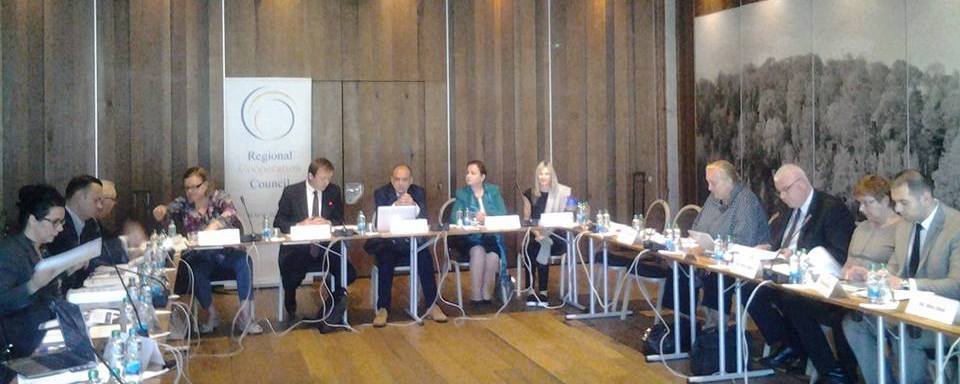
On May 14-15, 2015 the National Health Coordinators, Executive Committee members and technical experts of the SEE Health Network got together with the WHO Regional Office for Europe technical experts in the Preparatory Meeting of the SEE Health Network, met in Jahorina, Sarajevo, Bosnia and Herzegovina to finalize preparations towards the Ad-hoc meeting of the Ministers of Health of the Members States of the SEE Health Network, and the 35th SEEHN Plenary session, to be held back to back between 21-25 June, 2015 in Belgrade, Serbia. The Ministerial meeting of the SEEHN Member States is jointly called and organized by the Minister of Health of the Republic of Serbia and current President of the Network, Dr. Zlatibor Lonchar, and WHO Regional Director for Europe, Dr Zsuzsanna Jakab.
The Preparatory meeting was kindly organized and financed by the Regional Cooperation Council (RCC) in cooperation with the SEEHN Executive Committee. WHO Regional Office for Europe provided substantial political and technical support to the meeting.
Preparatory meeting scoped panel and group work over all the issues that will be taken aboard the SEEHN Belgrade event, and among others: discussing the implementation of WHO Europe Health2020, the Health dimension objectives and measures of the SEE 2020 Strategy, developing project proposals and revising the implementation report 2014; 4th SEE Health Ministers Forum, to be held in 2016; strengthened governance of the SEE Health Network; follow-up on the Ministers’ decisions from the Skopje Ministerial meeting in November, 2014; follow-up to the EC TAIEX and WHO Europe technical multi-country workshops in 2015, and many others.
[/column]
Years 2014 and 2015 have been and will be extremely intensive years for the regional collaboration for health, particularly with regards to the implementation of the Banja Luka Pledge (2011), the SEE 2020 Growth Strategy recently endorsed (22 November 2013) by the SEE Ministers of Economy, and embedding health as separate dimension contributing to the economic development and growth; the EU 2020 Strategy and the WHO Europe Health 2020 Policy Framework (2012) as well as the European Action Plan for Strengthening Public Health Capacities and Services (2012).
Because of the above and in view of the current political, economic, social and health changes that have taken place in the region since the endorsement of the SEE Health Network Memorandum of Understanding in 2008, it is of utmost importance that this Ministerial meeting is conducted accordingly in order to provide for strengthened leadership, managerial and technical opportunities for the Network and the regional cooperation in public health in SEE to develop further.
Recognizing the seriousness of the health workforce migration in recent years and the negative effects of brain drain and brain waste, the Republic of Moldova implemented the project “Better Managing the Mobility of Health Professionals” under the coordination of the World Health Organization.
Financially supported by the European Union, the project aimed to strengthen the capacity of the Republic of Moldova to manage the migration of Moldovan health professionals and to build up a better framework for the legal migration of health workers between Moldova and the EU in order to reduce or mitigate the negative impacts of migration on the Moldovan health system as well as to ease the reintegration of returning health workers.
Engaging a big team of WHO staff, experts, national authorities, medical institutions and medical education institutions both in the Republic of Moldova and from EU countries, the project incited and contributed to a 3-year-long fruitful collaboration that provided for substantial change in the HRH area in the country.
Achievements
One of the main project achievements is the development of a national information system (SIERUSS) to monitor the mobility of health professionals and the training of approximately 800 people in HRH governance and management and in using the SIERRUS database.
Furthermore, the project provided for the development of a relevant legislative framework and drafts of new regulations related to the employment and remuneration of health workers, improvement of both curricula for medical colleges and various postgraduate training programs, accreditation of the School of Public Health and Management as well as for the development of an e-learning platform at the University of Medicine and Pharmacy “Nicolae Testemitanu”.
An overview of all project activities, including the series of studies conducted in several European countries and the organization of dozens of policy dialogues, workshops and an information campaign, was given during the project closing conference held in March 2015. Also presented was a 20-minute movie summarizing the context, the challenges, the results and the lessons learned through views and opinions of Moldovan health professionals and WHO official representatives.
The Republic of Moldova as a SEEHN member
The example of the Republic of Moldova, one of the 10 member States of the SEE Health Network is to be commended. That was one of the reasons why the Republic of Moldova was authorized by the SEE Health Network to lead and coordinate the regional efforts on health workforce and its mobility through its designated Regional Health Development Centre in Chisinau.
Similar activities could and should be followed by the other SEE countries in either national and/or regional way. Health workforce is a major challenge for 9 of the 10 SEE Health network countries and is one of the four health objectives of the SEE 2020 Growth Strategy “Jobs and Prosperity in a European Perspective” which is currently in implementation with the support of the Regional Coordination Council, the European Commission DG Enlargement and many more international partners.