
Regional Director commends strengthened primary health care in Montenegro
Ms Zsuzsanna Jakab, WHO Regional Director for Europe, made an official visit to Montenegro on 26–28 March 2014, meeting HE Mr Milo Ðjukanović, Prime Minister of Montenegro, and Professor Miodrag Radunović, Minister of Health, and other high-level officials.
At her meeting with the Prime Minister on 27 March, the Regional Director commended the Government for making health a strategic priority and seeing it as an investment in the overall development of the country. She particularly praised efforts to revitalize primary health care, integrating preventive services and health promotion. The Regional Director advised, however, that, despite noteworthy improvements in life expectancy at birth and in child and maternal mortality in Montenegro, further investment is needed to tackle noncommunicable diseases (NCDs) and their risk factors – smoking, alcohol use, obesity and physical inactivity – and the broader social determinants of health.
National committee on NCDs to be established
The Prime Minister expressed his appreciation of WHO’s support in strengthening the health system and confirmed his commitment to the structural reform of the health sector. In addition, a national committee on NCDs would be established, consisting of ministers from different sectors and chaired by the Prime Minister, to ensure a more coordinated and effective multisectoral response.
In discussions with the Minister of Health, the Regional Director underlined the need to ensure that resources are used efficiently to maintain the financial sustainability of the health system, and to take further steps towards universal health coverage. This would mean cutting out-of-pocket payments for health care, as these increase inequalities.
Agreement signed between Montenegro and WHO/Europe
During the meeting, The Minister and the Regional Director signed a biennial collaborative agreement (BCA), establishing work priorities for WHO/Europe and the Ministry of Health for 2014–2015.
Further exchanges
The Regional Director’s official visit enabled her to visit the Medical Faculty of the University of Montenegro in Podgorica, meet health directors from all the public health institutions in Montenegro and describe Health 2020, the new European health policy, to them.
At a meeting with Mr Mitja Drobnič, Head of the European Union delegation to Montenegro, the Regional Director stressed the importance of health as a driver of sustainable development and pointed out the compelling need to address the premature mortality due to NCDs by tackling the risk factors and social determinants of health using a whole-of-government approach.
[divider type=”1″]
[/divider]
Presentation – Health 2020, a new European policy for health
27 March 2014, Podgorica, Montenegro
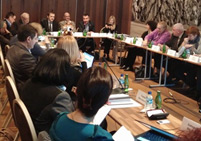
SEEHN Third Meeting on the SEE 2020 Strategy Implementation in 2014-2019
March 12-13, 2014, Jahorina, BiH
Following the Brussels Coordination Meeting (January, 2014), the RCC organized a SEE 2020 Coordination Meeting in Jahorina, Bosnia and Herzegovina. The meeting was attended by the SEEHN Presidency, Executive Committee members and the SEEHN permanent Working Group on SEE 2020 Strategy.
The purpose of the meeting was to discuss and agree on the SEEHN obligations and actions for SEE 2020 Strategy implementation, including on the:
- Monitoring of SEE 2020
- Implementing SEE 2020 through flagship initiatives
- Governing the implementation
- Work plan (2014 – 2019) of the health dimension objectives and measures under the Inclusive Growth pillar of the SEE 2020 Strategy
- Immediate needs in 2014 under the Presidencies of Romania and Republic of Serbia (Revisions of SEE Health Network basic legal documents; Concepts for the Fourth SEE Ministerial Forum; Next steps and timetable in 2014 and 2015)
Given the importance of monitoring of the implementation of the SEE 2020 Strategy, the meeting paid special attention to discussing and revising an OECD proposed set of measurable quantitative indicators for the health dimension. Having in mind the “health in all policies concept”, the health targets and indicators were restructured in order to fully align health prevention and promotion with it, while also having in mind the social determinants of health and inequalities. Agreeing on a revised set of quantitative indicators was one of the major outcomes of this meeting, and a first and very important step towards devising the full monitoring framework. The next step for completing this framework is to devise a set of qualitative indicators, which will follow later in 2014. A revision and further development of the flagship initiatives will also follow in the coming months.
Table 1: Proposed outcome and policy quantitative health indicators of the SEE2020 Strategy (Jahorina)
|
OUTCOME MEASURES & Data Sources |
Indicators of Impact by 2020 & Data Sources |
Annual Progress Measure & Data Sources |
Health Activities |
| Continued increase in life expectancy at current rate as (2006-2010)
% increase in healthy life years at age 65 % reduction in low birth weight % relative annual reduction in age-standardized overall premature mortality rate (from 30 to under 65 years) for four major noncommunicable diseases (HFA-MDB)
% Increase universal coverage % reduction in infant mortality per 1000 live births (HFA-DB) |
|
|
|
Recent Posts
- SEEHN Member States Strategic Consultations on the Bucharest Pledge and Future Regional Health Cooperation

- SEEHN Celebrates 25 Years of Regional Health Cooperation and Advances Innovation Agenda at 49th Plenary Meeting in Skopje

- World Blood Donor Day 2026: SEEHN Reaffirms Commitment to Voluntary Blood Donation and Regional Health Security