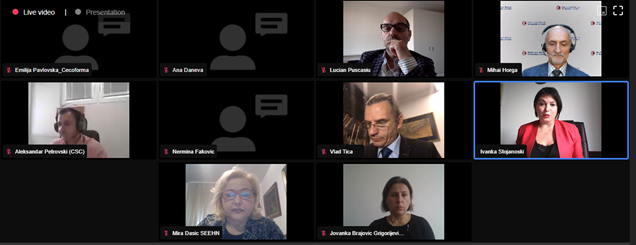
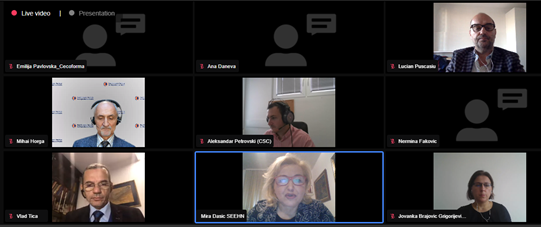
On November 9 and 10, a multicountry workshop on “Clinical guidelines on Sexual and Reproductive Health in SEEHN” was held virtually. The workshop was the result of SEEHN cooperation with the Ministry of Health of North Macedonia, the SEEHN Regional Health Development Centre on Sexual and Reproductive Health – the East European Institute for Reproductive Health of Romania and the European Commission’s Technical Assistance and Information Exchange Tool (TAIEX) that funded the workshop.
nnnn
nnnn
In her introductory statement, Dr. Dasic, Director of the SEEHN Secretariat, mentioned that COVID-19 has caused major failures and disruptions that need to be remedied as soon as possible so to reduce the inequality gap. SEEHN’s work will focus on counteracting the devastating consequences. “Low- and middle-income countries have suffered the most and have seen a decline in service delivery of up to 47%. WHO reports that the most frequently interrupted services on average included: unit-based services (61%); diagnosis and treatment of noncommunicable diseases (69%), family planning and contraception (68%), prenatal care (56%) and diagnosis and treatment of cancer (55%). Unfortunately, the impact will be far-reaching due to the increasing disparities between countries and within them. Our work will aim to reduce this,” she said.
nnnn
The purpose of this multi-country workshop is to strengthen the capacity of health professionals to develop and implement clinical guidelines for sexual and reproductive health services, which have been disrupted by the COVID-19 pandemic.
nnnn
During the two-day talks, the experts also discussed the current situation in the South Eastern Europe region and proposed a coherent and comprehensive national policy framework. In addition, experts provided advice on how to produce and promote good clinical practice in the best interests of the patient to improve the quality and effectiveness of healthcare.
“Mental Health and Resilience Training for HCWs responding to COVID-19 in SEE Region” kick-off meeting of the newly launched project took place on 8 November in the virtual space shared by National Focal Points and Mental Health experts from Albania, Bosnia and Herzegovina, Moldova, Montenegro, North Macedonia, Serbia and Kosovo*.
nnnn
Building on SEEHN Secretariat previous successful collaboration with Project HOPE and applying the training of trainers (TOT) approach, the current project aims to support SEEHN Member States and guests’ efforts to improve the well-being of health workers.
nnnn
The specific objective focuses on providing deeper knowledge and basic tools and techniques to build more personal resilience and, consequently, to achieve the systemic resilience that our health systems are in critical need of.
nnnn
Specific actions of this capacity building project include:
nnnn
1. Involvement of local health authorities and institutions in advocating for the mental health of health workers;
nnnn
2. Adaptation of HERO-NY training materials to the local context of target project participants by local mental health experts and local health workers; (slides of adapted material)
nnnn
3. Strengthen the capacity of health workers using HERO-NY adapted material and the Train the Trainers (ToTs) approach to create a group of trainers, eager to disseminate the information of their colleagues and exponentially increase the coverage of this training;
nnnn
4. Providing cascading sessions to other health workers.
nnnn
This project is developed and implemented by the SEEHN Secretariat and is funded by Project HOPE. It is expected to reach up to 8000 healthcare workers in the SEE region.
nnnn
The training sessions will address key concepts of stress, trauma and resilience, with specific reference to:
nnnn
Personal and professional wellness
Impact, effect & outcome on HCWs
Seeking help for ourselves & others
Resilience & wellness program development.
nnnn
Dr. Mira Dasic, Director of the SEEHN Secretariat, welcomed the participants at the kick-off meeting and emphasized in her opening remarks the devastating impact of the pandemic on mental health, with a focus on regional inequities. “The COVID-19 pandemic continues with different speed and another wave is escalating. At the same time, the mental health toll is in continuous rise and it is expected to last as a global phenomenon. The South Eastern Europe Region is a fragile region where during the pandemic increased the inequality gap and mental health issues are surging.” She stated in her intervention. The virtual session included a presentation of the training program and a review on the latest data within the research area. Exploratory discussions were held with participants on the project outline (objectives, activities, and dynamics) and their expectations regarding the outcome of the project.
Dr. Danijela Urošević, Chair of the South-Eastern Europe Health Network Executive Committee represented the Network at the Conference on The Role of the European Union in Strengthening Health Systems Resilience Globally.
nnnn
The event was held virtually, on October 20, 2021, under the auspices of the Slovenian Presidency of the Council of EU.
nnnn
The Conference aimed to identify a set of actions to support overcoming the COVID-19 crisis and better preparing for future pandemics. The key outcome of the conference called for a holistic, inclusive, and coordinated approach to health systems strengthening within Europe and beyond.
nnnn
Dr. Urošević’s intervention focused on the role and remit of the SEEHN and its contribution to the strengthening of the health systems within its Member States, on the prospects of the recently launched WHO Roadmap for Health and well-being in the Western Balkans (2021-2025) and on the promising opportunities to be addressed in partnership by EU and SEEHN.
nnnn
She also spoke on the Network’s 20th anniversary this year, highlighting the progress and contribution to health gains in the region. In her speech, she referred to the regional health development centres as drivers for regional cooperation and expertise, to the international partnerships that have built and continue to build core capacities within the Network Member States health systems, and to the deep-rooted principles that have guided the work of the Network over the years, such as solidarity, leaving no one behind and attaining the highest possible level of health.
nnnn
nnnn
Dr. Urošević emphasized the main pillars of the WHO Roadmap for Health and well-being in the Western Balkans, priority actions and reform initiatives in correlation with the SEEHN synergies that are seen regionally as important milestones aimed to re-build the economies of the WBs and promote an environment in which people thrive and have their health needs met.
nnnn
Last but not least, shared rules and enhanced cooperation between EU and SEEHN were highlighted as values that should underpin better and fairer reconstruction in the SEE region, while supporting direct mechanisms such as TAIEX to create positive outcomes in areas of common regional interest such as health emergency resilience, mental health, immunization agenda, digital health as well as behavioural and cultural insights.