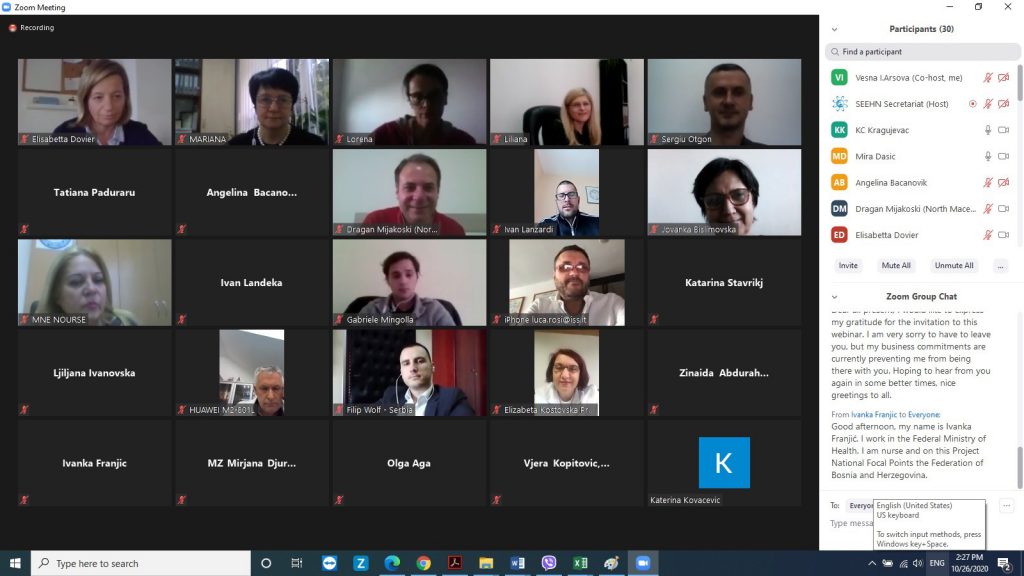
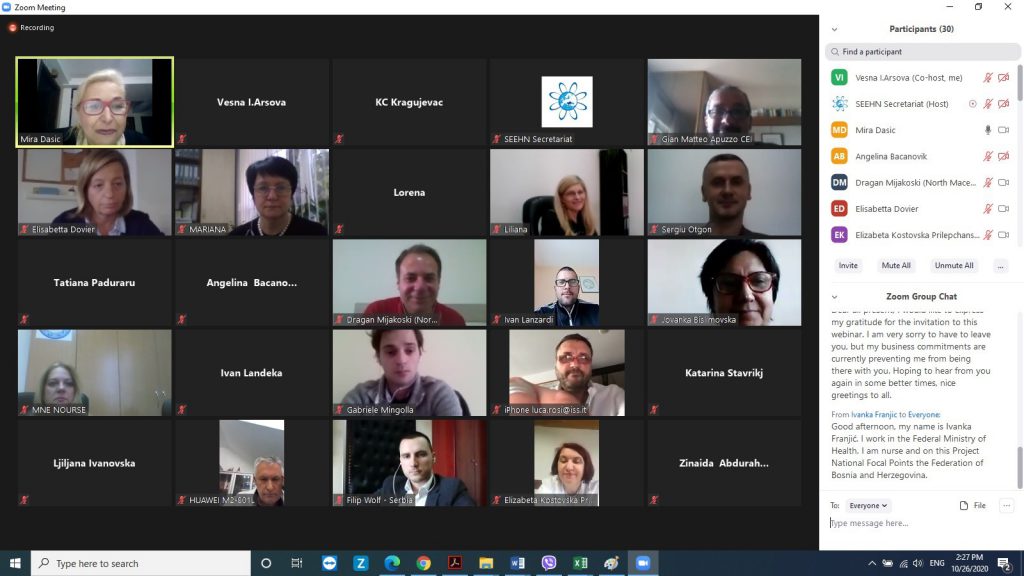
SEEHN Secretariat organized the First Regional Webinar “Primary Healthcare as main gatekeeper and crucial systemic element in the COVID-19 containment”, on 26 October 2020.
nnnn
This regional event is part of the project “Strong nurses for strong health systems and a healthier world” that is mainly funded by CEI and implemented by the SEEHN Secretariat in very close collaboration with SEEHN six Member States.
nnnn
Around 35 participants from BiH, MDA, MKD, MNE, SRB, CEI representatives and experts from the National Institute of Public Health from Italy’ and Lazzaro Spallanzani National Institute for Infectious Diseases’ and from the Istituto Superiore di Sanita’ joined online.
nnnn
Nurses are one of the core pillars of the health systems and are at the forefront of the COVID-19 response – providing care and playing a critical role in emergency risk reduction, preparedness and response. Primary health care nurses are often the first ones to get in direct contact with potential COVID-19 positive patients providing guidance and collecting samples for the diagnostic. They also provide the essential care for the patients, they coordinate efforts with other health professionals and other members of the response team during emergencies. Without well-prepared and protected healthcare staff, there is no effective response to health threats.
nnnn
Participants contributed to discussions on the primary health care crucial role as gatekeeper and first line contact with potential COVID-19 patients.
nnnn
Discussions focused on the ways to bridge the gap between nurses, patients and GPs and or hospitals in order to enhance community containment and to improve COVID-19 case-management. One of the highlighted nurses’ roles was on how to strengthen the prevention, promotion and advocacy work of the nurses.
nnnn
The COVID-19 pandemic is still not entirely known, evidence is gathered on the way and it is essential to have a regional platform to share experience. Every piece of information counts, any new way of doing things matters to improve efforts against COVID19.
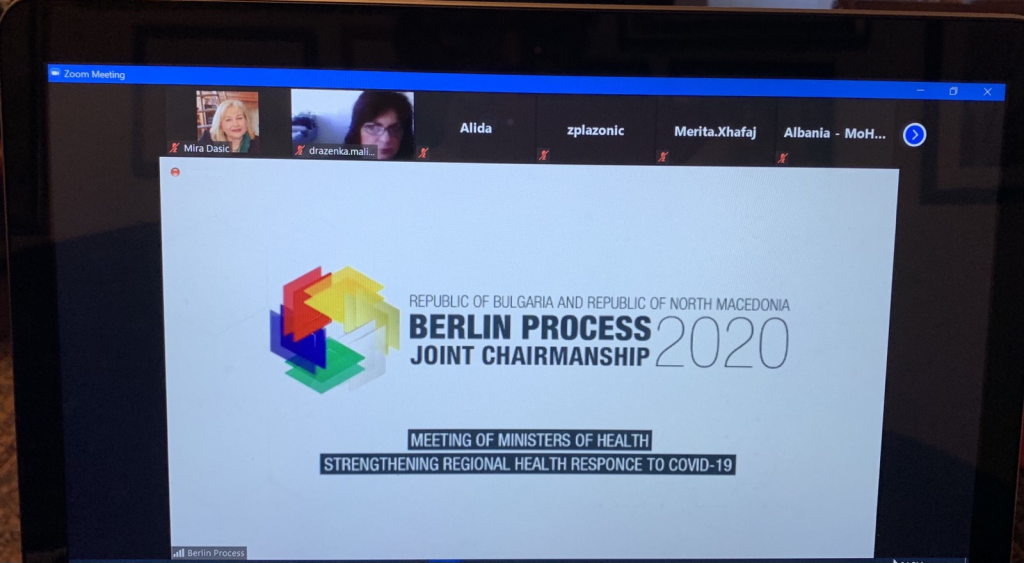
Dr. Mira Dasic, Director of the SEEHN Secretariat participated at the online Meeting of the Ministers of Health within the Berlin Process, on 22 October 2020 co-chaired by North Macedonian Minister of Health, Dr. Venko Filipche and the Bulgarian Health Minister Dr. Kostadin Angelov.
nnnn
For the first time this year, the Health sector has been included on the agenda. The discussions focused on the COVID-19 health response in the region and beyond. It comprised dialogues on coordinated approach to free movement of people, goods and services while keeping the epidemic situation under control.
nnnn
EU representative on Health and Crisis Management, Advisor Ms Isabel De la Mata, WHO Regional Director for Europe Dr. Hans Kluge, prof. Dr. Johanna Hanefeld from the Center for International Health Care, Robert Koch Institute, Dr. Andrea Aman Director of the European Center for Disease Prevention and Control and Dr. Mira Dasic, SEEHN Secretariat Director, joined these high-level discussions. Representatives from Albania, Bosnia and Herzegovina, Bulgaria, Croatia, Italy, Kosovo*, Montenegro and Poland also contributed to this important meeting.
nnnn
The flu season started and the incidence of COVID is raising in all the countries over the South Eastern Europe Region and this meeting was of outmost importance to discuss the next package of measures to contain the outbreak and to support Western Balkan populations and beyond. It was also highlighted that at this critical time the support of international donors is of utmost importance.
nnnn
During her intervention, Dr. Dasic mentioned some of the SEEHN specific activities linked to the outbreak.
nnnn
Among them are:
nnnn
Building critical skills and knowledge necessary for health workers to respond rapidly and efficiently to COVID-19;
Assessment of the stress and burn out among the healthcare workers during the COVID-19 pandemic;
Increase of the knowledge on COVID-19 among Primary Health Care nurses;
Establishing of the Thematic Network on Sexual and Reproductive Health to gather more data on the COVID-19 associated pregnancies and newborns.
nnnn
Throughout this COVID-19, pandemic one thing came clear that no single country or organization can face these global and regional public health challenges alone. For this reason, establishing and strengthening partnerships will be another key component for all counterparts’ efforts ahead.
nnnn
One of the outcomes of this meeting is the establishment of a system of information exchange on the pandemic management experiences in the region. It is extremely important to foster better coordination in Western Balkan countries and beyond to be able to cope effectively with the COVID-19 pandemic in the next period.
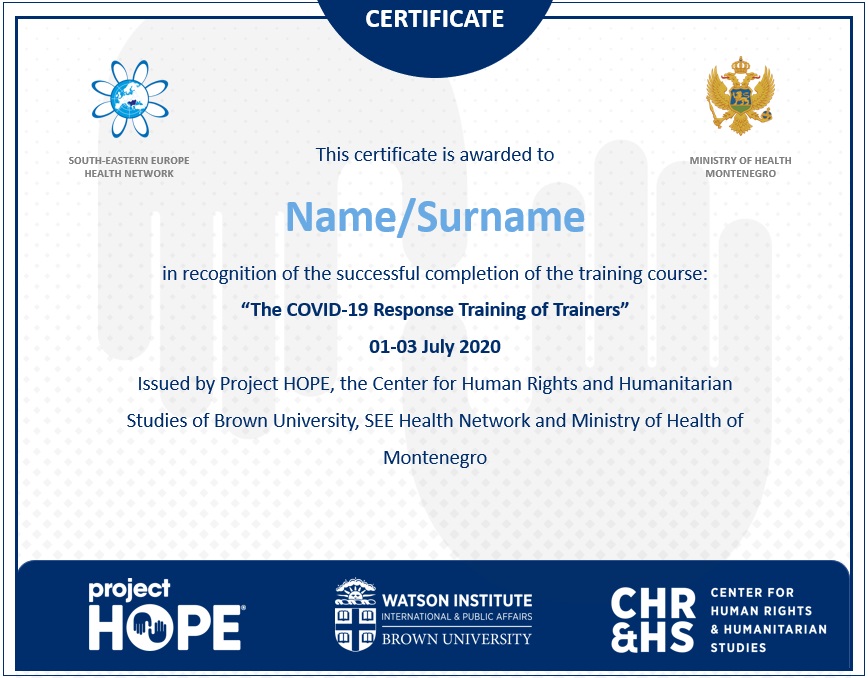
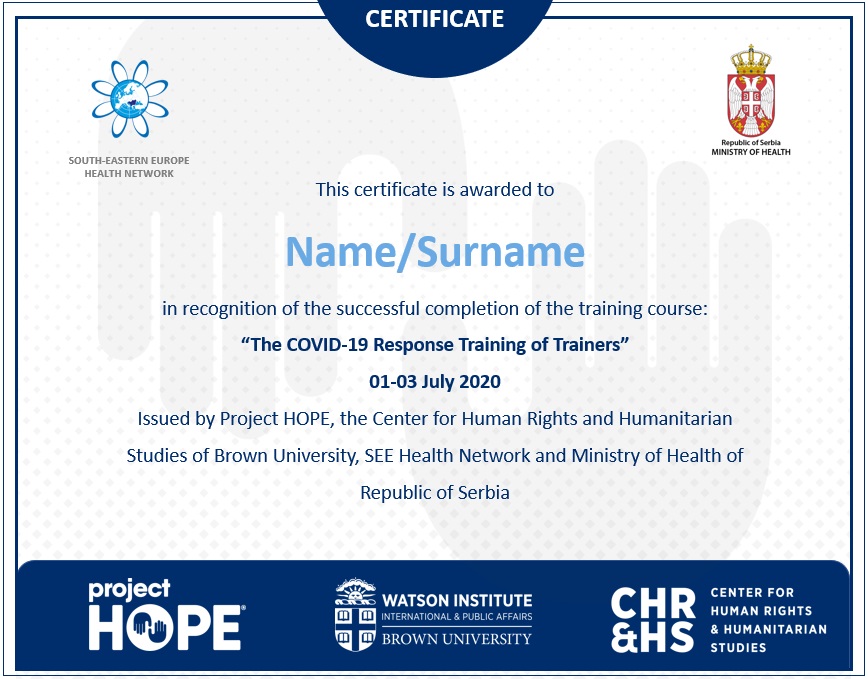
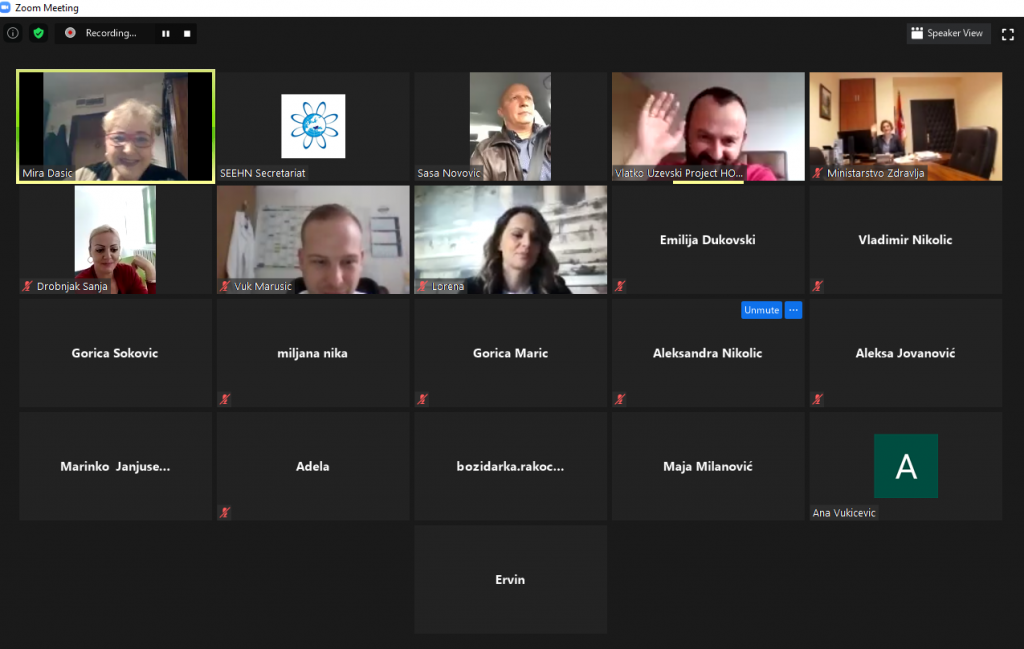
In the first phase of the COVID- 19 Training of trainers, 32 participants from Albania, Montenegro and Serbia successfully completed the online training course and were awarded certificates during the online ceremony held on 8 October 2020.
nnnn
The SEEHN Secretariat teamed up with Project Hope to develop a six-month COVID-19 ToT online program for healthcare workers, designed to teach and evaluate the trainees from the selected SEEHN Member States on core competencies, including on infection prevention and control; contact tracing; screening and triage; diagnosis and management; and risk communication and public health messaging.
nnnn
ToT model for healthcare workers was developed by Project HOPE in partnership with experts from Center for Human Rights and Humanitarian Studies at the Watson Institute of Brown University, United States. The training materials were translated to Albanian, Montenegrin and Serbian and will be used during the second dissemination phase that will be conducted in the forthcoming period by the certified trainers.
nnnn
SEEHN Secretariat extends its appreciation to Project HOPE for the partnership in this important training program as part of a joint effort to rapidly scale-up COVID-19 response in the selected SEEHN member states. The Secretariat also expresses its gratitude to the national focal points and to the training participants for their efforts and contributions for the successful implementation of the program.
nnnn
SEEHN reaffirms its commitment to further working on strengthening the health workforce capacities in SEE region.